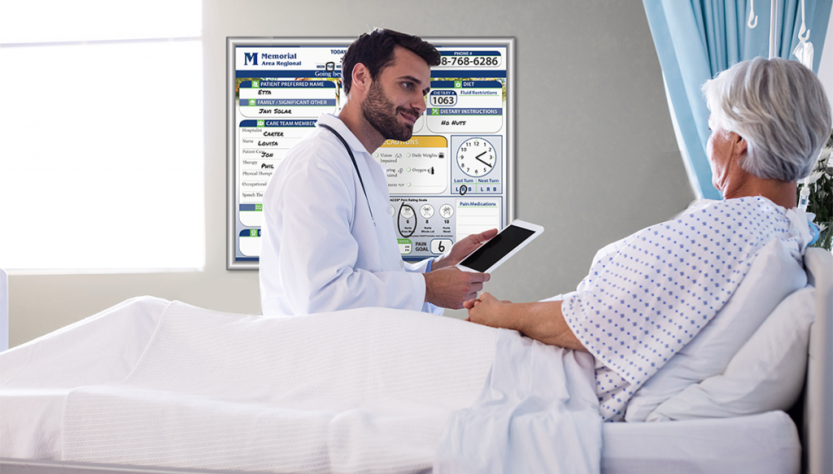
Whiteboard systems in hospital settings function as structured communication infrastructure connecting patients, families, nursing staff, and physicians through a shared visual medium available without technology access or clinical training. Their contribution to patient safety outcomes is documented across multiple care settings and integrated into Joint Commission accreditation expectations.
How Do Unit-Level Whiteboards Affect Care Coordination?
Nursing unit status boards displaying patient census, acuity levels, care team assignments, and pending orders have been associated with measurable reductions in response time for time-sensitive interventions.
Research published in Nursing Management found that units implementing structured daily goal tracking on unit-level status boards experienced 2 measurable clinical improvements:
- 22% reduction in average length of stay for surgical patients
- 17% reduction in post-discharge readmission rates at 30 days, compared to control units without structured board protocols
What Disinfectant Compatibility Is Required in Acute Care Settings?
Hospital whiteboards face a cleaning environment fundamentally different from commercial or education applications. High-level disinfectants including bleach-based solutions, hydrogen peroxide vapor, and quaternary ammonium compounds at clinical concentrations are applied on daily or multiple-daily schedules in acute care settings.
Facilities managers specifying healthcare whiteboards for acute care environments should require 2 documents from manufacturers before accepting product substitutions:
- Chemical compatibility certification showing surface resistance to the disinfectants in the facility’s infection control protocol
- Accelerated cleaning cycle test data showing surface integrity after 500 or more disinfection cycles
Should Healthcare Facilities Specify Antimicrobial Whiteboard Surfaces?
Antimicrobial surface treatments for whiteboards provide an additive hygiene benefit rather than a substitute for scheduled disinfection. Silver-ion antimicrobial treatments incorporated into whiteboard surface materials demonstrate lower interim surface bioburden counts between scheduled cleanings compared to untreated surfaces of equivalent material.
Healthcare facilities pursuing WELL certification alongside clinical quality initiatives benefit from specifying boards whose antimicrobial surface treatment contributes to WELL Nourishment and Hygiene concept documentation.
What Is the Link Between Patient Room Whiteboards and HCAHPS Scores?
HCAHPS patient satisfaction surveys include 3 question categories where standardized patient room whiteboard use with daily goal documentation shows positive associations with survey scores:
- Communication with nurses: boards that display the nurse’s name and shift hours produce higher recognition scores
- Communication with doctors: boards documenting the attending physician’s name and daily plan reduce the frequency of patient uncertainty about care team identity
- Understanding care: boards with discharge planning zones produce higher patient-reported understanding of their care plan at discharge